How Much Does MVP App Development Cost? (Process, Pricing & Timeline)
Launching a full product without validation can burn $50,000–$100,000+—and still fail.
That’s not bad luck. That's a bad strategy.
Smart founders don’t start big. They start to lean—with an MVP.
This guide will show you:
What an MVP actually is (and what it is not)
The difference between MVP, prototype, and proof of concept
Real MVP development costs (no fluff numbers)
Timeline and process to launch faster
Cost-saving strategies most founders ignore
What Is an MVP?
A Minimum Viable Product (MVP) is a working version of your product with only the core features needed to solve a real problem.
It’s not a half-built app. It’s a focused product designed for validation.
Instead of building everything at once, you:
- Launch quickly
- Test with real users
- Collect feedback
- Improve based on data
Validate your idea before scaling.
MVP vs Prototype vs Proof of Concept
Most founders mess this up—and waste money because of it.
Proof of Concept (PoC)
Tests if your idea is technically possible
Used internally
No real users
Not a product
Key Question: Can we build this?
Prototype
Visual or clickable design
Used for user experience testing
No backend or real functionality
Key Question: Does it look and feel right?
MVP (Minimum Viable Product)
Fully functional product
Used by real users
Collects real data
Can generate revenue
Key Question: Will people actually use and pay for it?
Simple Breakdown
PoC = Can we build it?
Prototype = Will users understand it?
MVP = Will users pay for it?
How Much Does MVP App Development Cost?
Let’s cut the vague answers.
Most MVPs fall into this range:
Typical MVP Cost
$10,000 – $50,000+ for a scalable MVP
But here’s the reality:
Cheap MVPs often fail because they are built without strategy.
Expensive MVPs fail because they are overbuilt.
The sweet spot is building only what matters.
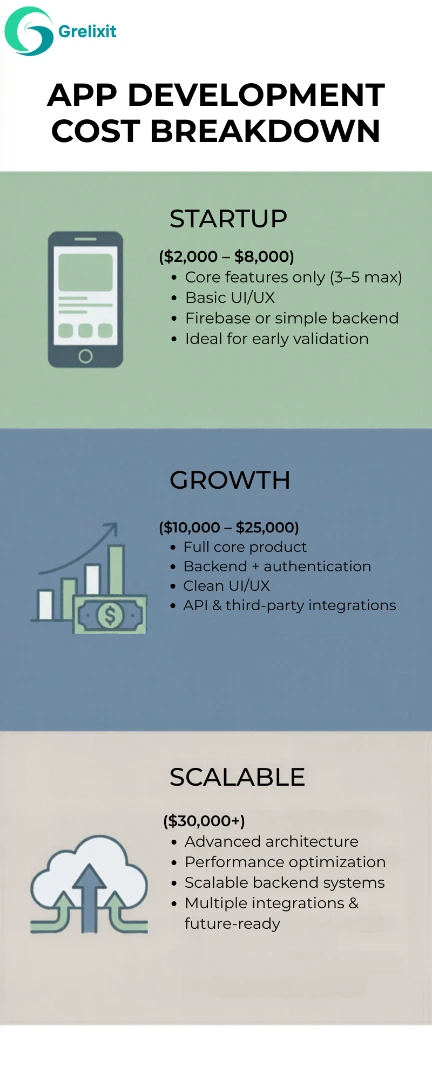
Investment Levels
1. Starter MVP ($2,000 – $8,000)
Core features only (3–5 max)
Basic UI/UX
Firebase or simple backend
Ideal for early validation
2. Growth MVP ($10,000 – $25,000)
Full core product
Backend + authentication
Clean UI/UX
API & third-party integrations
3. Scalable MVP ($30,000+)
Advanced architecture
Performance optimization
Scalable backend systems
Multiple integrations & future-ready
MVP Development Timeline
Typical MVP timeline:
Planning: 1–2 weeks
Design (UI/UX): 2–4 weeks
Development: 6–12 weeks
Testing & Launch: 2–4 weeks
Total: 12 to 24 weeks
Speed depends on:
Feature complexity
Team experience
Tech stack
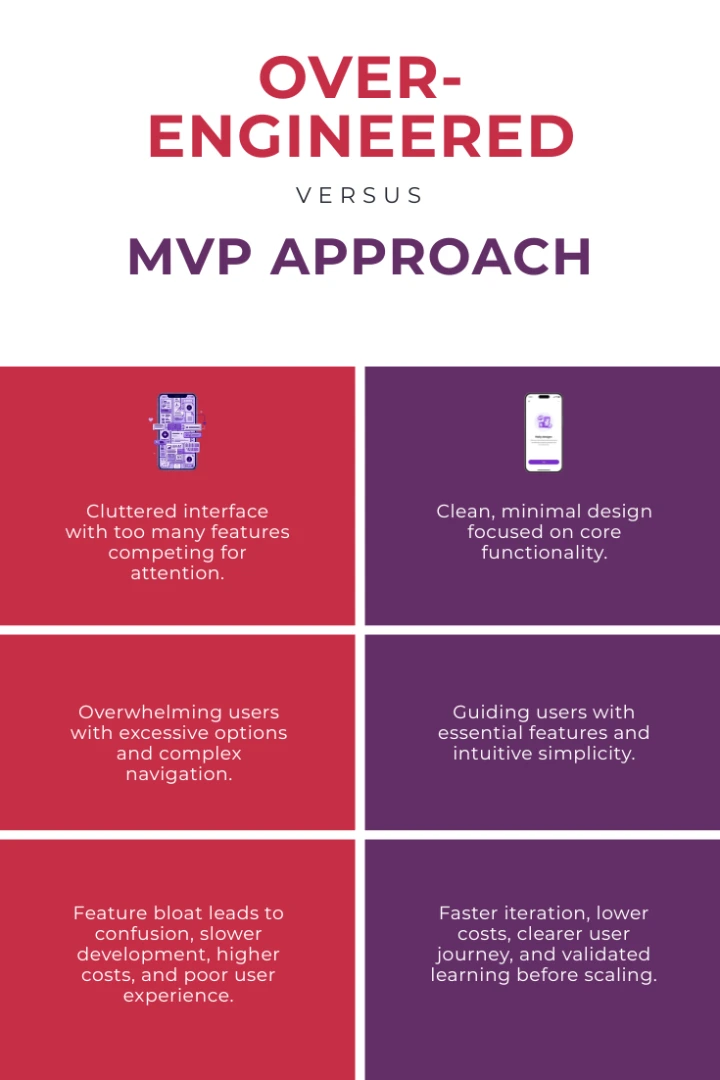
The Biggest Mistake Founders Make
Trying to build everything at once.
This leads to:
Higher costs
Delayed launch
No real validation
Burned budget before traction
If your MVP has 15 features, it’s not an MVP. It’s a mistake.
The Smarter Approach
Follow this loop:
Build → Launch → Learn → Improve
This is how startups reduce risk and grow faster.
Factors That Affect MVP Cost
Not all MVPs cost the same. Here’s what actually drives pricing:
1. Feature Complexity
More features = more time = higher cost
2. Platform (iOS, Android, or Both)
Native apps cost more
Cross-platform (Flutter) reduces cost significantly
3. Backend & Infrastructure
Apps with:
Real-time data
Cloud systems
Large databases
- Cost more to build and maintain
4. UI/UX Design
- Custom UX = higher engagement (but costs more)
- Basic UI = cheaper
5. Third-Party Integrations
Payment gateways
APIs
CRM systems
Analytics tools
Each integration increases complexity
6. Scalability Planning
Building scalable architecture early:
Costs more initially
Saves money long-term
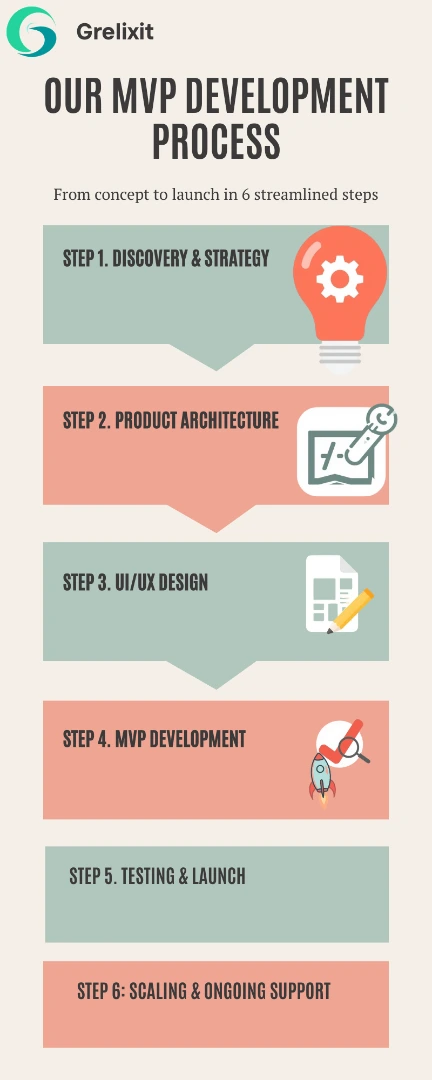
How We Build MVPs (Our Process)
At Grelixit, we follow a structured approach designed to move fast without breaking scalability:
Step 1: Discovery & Strategy
We start by understanding your business goals, target users, and product vision.
This ensures we’re building something people actually need—not just features.
Step 2: Product Architecture
Before writing code, we design a scalable system architecture.
This includes database structure, APIs, and infrastructure planning to avoid future bottlenecks.
Step 3: UI/UX Design
We create intuitive and user-friendly designs focused on engagement and usability.
The goal is simple: make your product easy to understand and use from day one.
Step 4: MVP Development
We build a functional product with only the core features required for launch.
This allows faster time-to-market and real user feedback.
Step 5: Testing & Launch
We rigorously test the application for performance, security, and stability before launch.
Then we deploy your product and ensure everything runs smoothly.
Step 6: Scaling & Ongoing Support
After launch, we help you scale your product, optimize performance, and add new features based on real user data.
Why Choose Grelixit?
We focus on one thing: launching fast without wasting money.
Cross-platform mobile apps (Flutter)
Scalable backend systems (.NET, Firebase)
Custom web apps (React, Svelte)
Integration with Shopify, Odoo, Stripe
We don’t overbuild. We build what matters.
MVP Launch Offer (Limited Slots)
If you're planning to build an MVP, here’s what you get:
Free 30-min MVP Strategy Call
Custom MVP Scope & Cost Breakdown (Worth $200+)
Up to 15% Discount on Development
Free landing page
Free Firebase deployment
We only take 3–5 projects per month to maintain quality.
FAQs
1. How much does MVP app development cost in 2026?
MVP app development typically costs between $2,000 and $30,000+, depending on feature complexity, scalability requirements, integrations, and platform choice.
At Grelixit, our MVP pricing is structured into:
- Starter MVP: $2,000 – $8,000
- Growth MVP: $10,000 – $25,000
- Scalable MVP: $30,000+
2. Why do MVP development costs vary so much?
MVP costs depend on several factors:
- Feature complexity
- Mobile vs web platform
- Backend infrastructure
- Third-party integrations
- UI/UX design quality
- Scalability planning
A simple validation MVP costs far less than a scalable SaaS platform.
3. What is included in MVP app development?
A professional MVP typically includes:
- Discovery & strategy
- UI/UX design
- Frontend and backend development
- Authentication system
- API integrations
- Testing & deployment
The goal is to build a functional product with only the core features needed for launch.
4. How long does MVP development take?
Most MVPs take between 12 and 24 weeks.
Typical timeline:
- Planning: 1–2 weeks
- UI/UX Design: 2–4 weeks
- Development: 6–12 weeks
- Testing & Launch: 2–4 weeks
Timeline depends on feature scope and project complexity.
5. What’s the difference between an MVP, prototype, and proof of concept?
- Proof of Concept (PoC): Tests technical feasibility
- Prototype: Visual or clickable design for UX testing
- MVP: Functional product used by real users
An MVP is the first version capable of validating real market demand.
6. Is it better to build an MVP or a full product first?
For most startups, building an MVP first is the smarter strategy.
An MVP helps you:
- Validate demand
- Reduce risk
- Launch faster
- Collect real feedback before scaling
Building a full product too early often leads to wasted budget and unnecessary features.
Get Your MVP Cost Estimate
Planning to build your MVP?
Let’s break down your idea and find the fastest path to launch.