MVP Mobile App Development for Startups: Complete Guide
Launching a startup product is a race against time.
Many founders spend months building full-featured applications—only to realize the market doesn’t need half of what they built. This leads to wasted budget, delayed launches, and missed opportunities.
That’s why smart startups focus on MVP app development.
An MVP (Minimum Viable Product) allows you to build a functional version of your app, validate your idea quickly, and scale based on real user feedback.
What is MVP App Development?
MVP app development is the process of building a simplified version of your application with only the core features needed to solve a specific problem.
Instead of overbuilding, startups:
Launch faster
Reduce development cost
Test real user demand
Improve based on feedback
Why MVP Development is Critical for Startups
1. Faster Time to Market
Speed is everything. MVPs allow you to launch in weeks instead of months.
2. Cost Efficiency
You only build what’s necessary—avoiding wasted development expenses.
3. Real Market Validation
Instead of assumptions, you get real user data.
4. Scalable Foundation
A well-built MVP can evolve into a full product without rebuilding from scratch.
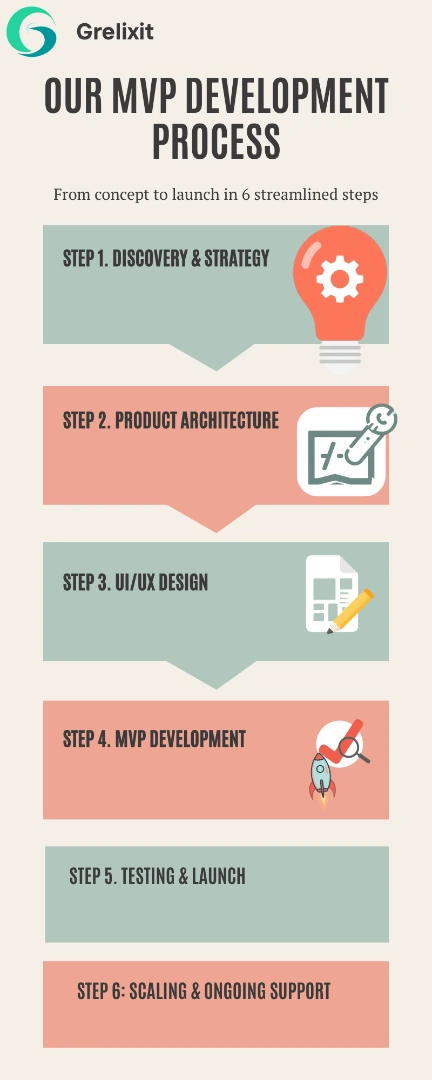
MVP App Development Process (Step-by-Step)
At Grelixit, we follow a structured and efficient development process:
Step 1: Discovery & Strategy
We start by understanding your business goals, target users, and product vision.
This ensures we’re building something people actually need—not just features.
Step 2: Product Architecture
Before writing code, we design a scalable system architecture.
This includes database structure, APIs, and infrastructure planning to avoid future bottlenecks.
Step 3: UI/UX Design
We create intuitive and user-friendly designs focused on engagement and usability.
The goal is simple: make your product easy to understand and use from day one.
Step 4: MVP Development
We build a functional product with only the core features required for launch.
This allows faster time-to-market and real user feedback.
Step 5: Testing & Launch
We rigorously test the application for performance, security, and stability before launch.
Then we deploy your product and ensure everything runs smoothly.
Step 6: Scaling & Ongoing Support
After launch, we help you scale your product, optimize performance, and add new features based on real user data.
How Much Does MVP App Development Cost?
The cost of MVP development depends on:
- Number of features
- Complexity of the system
- Platform (iOS, Android, Web)
- Backend requirements
Typically, MVP development can range from $2k to $50,000+, depending on the scope.
The key is not cost—it’s building the right product first.
Best Technology for MVP Development
Modern startups prefer cross-platform development using frameworks like Flutter.
Benefits include:
Faster development
Lower cost
Single codebase for iOS & Android
Scalable performance
Common Mistakes Startups Should Avoid
Stop doing:
Building Too Many Features
Ignoring User Feedback
Choosing the Wrong Development Team
Focus on:
Focus only on what solves the core problem.
Your users should guide your product evolution.
Poor technical decisions lead to long-term problems.
How Grelixit Helps You Launch Faster
At Grelixit, we specialize in building scalable MVPs and custom software solutions.
Our services include:
Custom software solution development
MVP app development for startups
UI/UX design and implementation
Backend and API development
Ongoing maintenance and support
We don’t just build apps—we help you:
- Launch faster
- Reduce risk
- Scale efficiently
Conclusion
MVP app development is not just a development strategy—it’s a smarter way to build products.
By focusing on speed, validation, and scalability, startups can avoid costly mistakes and move forward with confidence.
FAQs
1. How long does it take to build an MVP?
Most MVPs take 12–24 weeks depending on complexity, features, and integrations.
2. What is the difference between MVP and full product?
An MVP includes only core features to validate an idea, while a full product includes advanced features, scalability, and optimization.
3. Can I build an MVP for both iOS and Android?
Yes. Using cross-platform technologies like Flutter allows you to build for both platforms faster and more cost-effectively.
4. Do I need a technical team to build an MVP?
No. You can work with a development partner who handles design, development, and deployment.
5. What happens after the MVP is launched?
After launch, you collect user feedback, improve features, fix issues, and gradually scale the product.
6. Is MVP development suitable for non-tech founders?
Yes. MVPs are specifically designed to help non-technical founders validate ideas before investing heavily.
Start your MVP
Planning to build your MVP app?
Let’s help you turn your idea into a scalable product—without wasting time or budget.